01 / 05
Overview
7 parts, one idea.
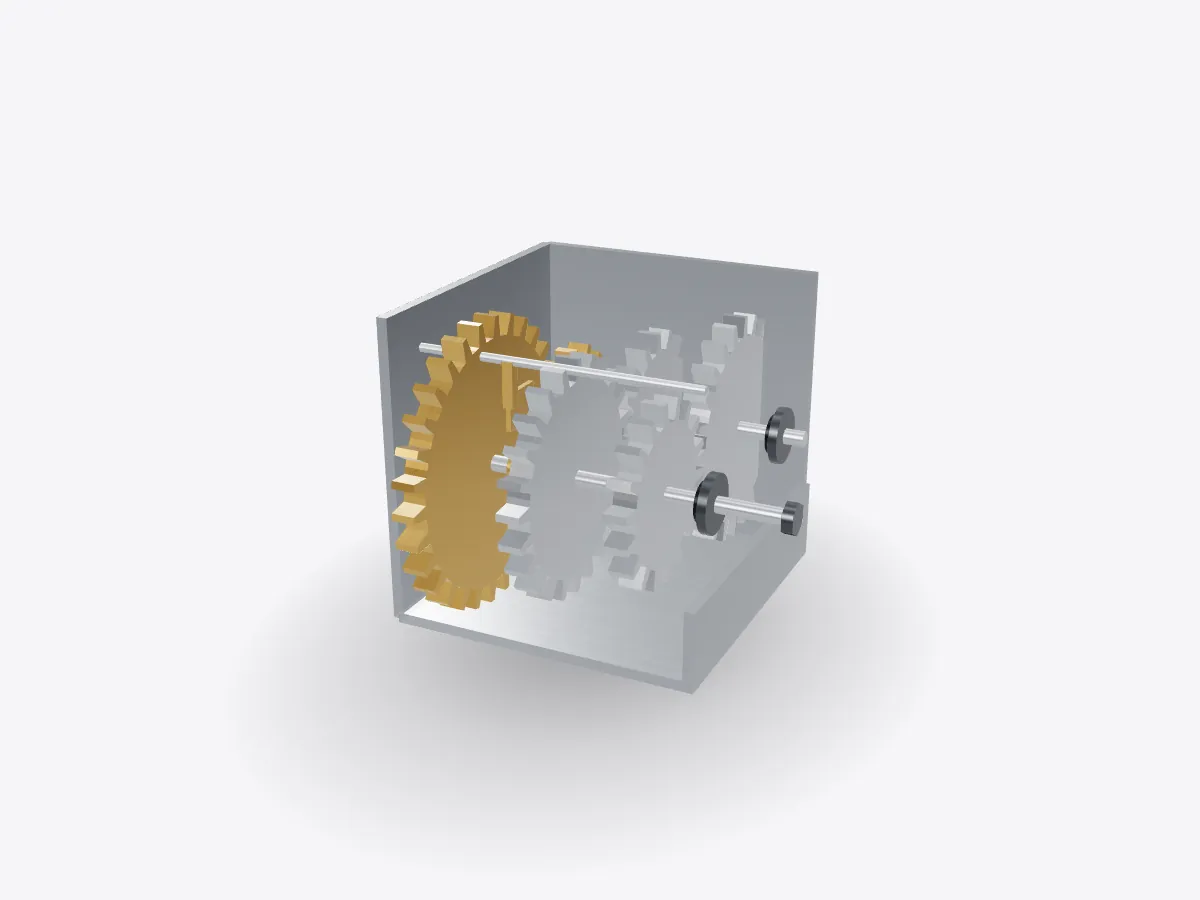
Watch a manual gearbox's gears mesh in 3D. See input and output shafts, gear ratios, bearings and the selector fork, then slice it open and rebuild it.
Drag to orbit, pinch or scroll to zoom, tap any part.
How it works · Machines
Engines like to spin fast; wheels need to start slow and strong. A gearbox trades one for the other, one pair of teeth at a time.
Scores are saved on this device only.
01 / 05
Overview
Watch a manual gearbox's gears mesh in 3D. See input and output shafts, gear ratios, bearings and the selector fork, then slice it open and rebuild it.
Drag to orbit, pinch or scroll to zoom, tap any part.
02 / 05
Explode
Keep scrolling and every part slides away from the centre, so you can see how they fit together.
03 / 05
Slice
A section plane sweeps through the model as you scroll. Pick an axis and set the depth yourself.
04 / 05
Parts
Pick a part or tap a glowing dot. It lights up and everything else fades back.
05 / 05
Facts
In the gold first-gear pair, a 12-tooth gear drives a 30-tooth gear, so the output turns 2.5 times slower.
Two meshing external gears always turn in opposite directions.
Manual car gearboxes keep their gears meshed and lock one pair at a time.
Explained
An engine only produces useful power across a limited band of speeds, while a car's wheels need to turn anywhere from a crawl to motorway speed. A gearbox bridges that gap. By choosing which pair of gears carries the power, it changes how many times the wheels turn for each turn of the engine, and in doing so it changes the torque, or twisting force, delivered to the wheels.
The rule is simple. When a small gear drives a large one, the large gear turns more slowly but with more torque, in proportion to the number of teeth. In the gold pair in this model, a 12-tooth gear drives a 30-tooth gear, a ratio of 2.5 to 1. The output shaft turns 2.5 times slower than the input, and, ignoring friction losses, with 2.5 times the torque. That's what first gear is for: getting a heavy car moving from rest.
It's tempting to imagine gears sliding in and out of contact when you change gear, and some very early gearboxes did work that way. Modern manual gearboxes are constant-mesh designs. Every forward gear pair is meshed all the time. The driven gears spin freely on the output shaft on bearings, so most of them are just idling round. To select a gear, the selector fork slides a collar along the shaft. Teeth on the collar, called dogs, engage with matching teeth on the side of the chosen gear and lock it to the shaft, so that pair now carries the power.
Before the dogs can engage, the gear and the shaft need to be turning at the same speed. That's the job of the synchroniser, a cone clutch built into the collar that rubs the two parts to the same speed in a fraction of a second. It's why a modern gearbox changes smoothly without the double-declutching drivers once needed.
The teeth themselves are carefully shaped, usually with a curve called an involute, so that they roll against each other smoothly and the speed ratio stays constant through each tooth's contact. The shafts are held in rolling bearings in a rigid housing that keeps the gears exactly the right distance apart, and oil splashed around inside carries away heat and stops the teeth from wearing. Press play to watch the three pairs in this model turn at their three different ratios at once.
D3DDD
D3DDD makes them: product cutaways, exploded views, architectural renders and technical drawings.